A memoir in graphic form...
Guardian Review
Oops, reviewer preferred Fun Home
.New York Times Review
Total Pageviews
Sunday, February 23, 2014
Friday, February 14, 2014
A Sense of an Ending and B.B.'s Parish Book Group
After reading “A Sense of an Ending" with the Sixth Street Book Group, I recommended it to our parish group. A day or two before we met, a fellow member asked why in the world I’d recommended that book. So I had to think about why I think it has religious themes. It occurred to me that one parallel is the story of the Pharisee and the tax collector. The former goes into the Temple, marches up front and says, “Thank you, God, for not making me like other men—such as that tax collector.” The tax collector stays at the rear, beating his breast and saying, “Forgive me, Lord, for I am a sinner.”
Tony starts out like the Pharisee and ends up like the tax collector. His life is neat and tidy, no mess. He sees himself as a decent man. In the course of the story he comes to realize that he has never loved anyone. He threw Veronica over because he thought she and her family looked down on him. When the American girl he hitchhiked with said “Easy come, easy go” it didn’t occur to him until much later that maybe this was a question rather than a comment.
When his unfaithful ex-wife suggested they might reunite, he thought the idea too “odd” to carry through on—besides, he’s become content living alone. When Tony finally rereads the hateful letter he wrote to Adrian and Veronica he can no longer pretend that it was a mild rebuke and not a curse.
All along, Veronica has been saying Tony “doesn’t get it.” When epiphany finally comes, he’s no longer complacent. Instead, reprising a school chum’s assessment of history, there’s “unrest, great unrest.” It’s not that Tony is completely responsible for what went wrong, but like a world war there’s a chain of causes and he comes to realize that he’s a link in the chain. He’s not better than other men, after all, and as much in need of mercy as anyone else.
I Curse the River of Time: Discussion update 2/15/14 with comment from B.B.
The beauty of a book group filled with bright, insightful women is that discussion leads to deeper understanding and appreciation of a book--even one that you might not like. Not that the majority didn't like the book; most did. But what individuals say during a meeting can make a difference in how you relate to the book's characters and ultimately how you feel about the book. And I think this was true for I Curse The River of Time.
Another great feature of our book group is the sponsor's intro which often gives some clarity as to the author's demons, motivations, and themes. J.B. honed in on this biographical fact--Petterson's mother read his first novel and said it was childish. A week later she was dead along with his father, brother, and nephew in a ferry accident. Could that harsh statement have haunted Petterson into writing this novel?
Petterson interview.

YEAH: The other B (BB) reports...
Another great feature of our book group is the sponsor's intro which often gives some clarity as to the author's demons, motivations, and themes. J.B. honed in on this biographical fact--Petterson's mother read his first novel and said it was childish. A week later she was dead along with his father, brother, and nephew in a ferry accident. Could that harsh statement have haunted Petterson into writing this novel?
Petterson interview.

Members had lots to discuss about this novel about a 37 year old not quite adult, well childish, man--Arvid--and his dying mother, his dying marriage, and his dying dream for a communistic worker's paradise. (Not as dark as it sounds--the November mood was lightened a bit with bitter sweet poignancy and even some comic situations--well comic to some.) The flow of talk didn't stop or veer off from figuring out just what this book meant to us.
Still longing to be his mother's favorite son, Arvid, seems to overlook or minimize the evidence that he might be. There was quite a lot of evidence as one member pointed out and she triggered a whole list...He was the only son who was planned, who shared the love of reading with his mother,who as a child would rise early to share early mornings with her, who could come into her presence and she would know it was him without even looking.
I guess despite the fact that his mother loved him--it wasn't enough, because she didn't idolize him; she knew him too well. She knew he wasn't the one who triggered the divorce; she knew he was naive enough to think staying in the working class would be a heroic act; she didn't think about him every day as she did about her son who died. (Why would she? asked a member...She knew he was alive and okay.)
Arvid at 37 did not have the life he dreamed of having. Yet some felt that he would be redeemed just because he could be so brutally honest about who he was. And that his depths of despair will lead him into a more evolved, Arvid--the Arvid who is the narrator.
Themes & Misc.
The river of time--Because even though a mighty river like the Rio Grande could dry up and be crossed--(read the novel to if this metaphor doesn't quite make sense)--we can't go back to undo, redo, relive, reconnect. We are flowing along with time in one direction only and missed opportunities are missed forever.
Families--especially Scandinavian ones in winter? can't talk about painful secrets, hidden shames, regrets, and or even, strong feelings of love. They speak through actions--a shared Napoleon pastry, the sharing of a brandy.
Hemingway and Faulkner influence in writing style.
Others were mentioned, but alas, I regret almost to the point of cursing, that I did not take notes this time. So if you like, send them in comments. I will post.
YEAH: The other B (BB) reports...
We did talk briefly of the transcendence Arvid yearns for, seeks and at times attains. He envies what he sees in a group of young Christians, but, because he doesn’t believe in God, he doesn’t join them. He becomes intrigued with the teachings of Mao and quits college to immerse himself in the working class. In one scene, he feels himself part of a we (the italics are the author's), only one humble man but a part of all humanity. His mother called him an idiot and his wife a child, but perhaps it takes a simpleton or child to attain mystical heights. And maybe that compensates for the loss of material success.
And if we see Arvid as a stand-in for the author—as members of our group proposed—then perhaps there’s the suggestion that artistic success compensates for failure in other aspects of life.
Sunday, January 26, 2014
Sunday, January 19, 2014
Friday, January 17, 2014
Discussion of The Messiah of Stockholm by Cynthia Ozick
A number of coincidences: the second book of the year that was found on a Park Slope stoop.(No Kindles left out yet; only paper versions.) The second book in a row about a real author--Bruno Schulz. Last month was Edith Wharton. (Although that isn't so unusual others pointed out...we read a fictionalized version of Henry James.) And, perhaps, the most surprising of all, one of the book group members relatives came from and died in Drohobych? Drogobych? Poland as did Bruno Schulz.

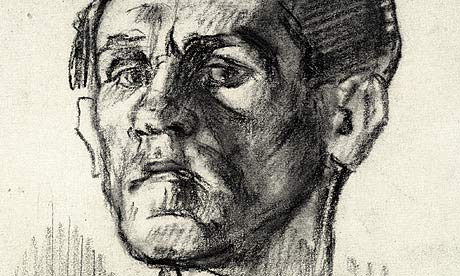
At
once direct and arcane ... a self-portrait drawing by Bruno Schulz
What was the overall impression of the book? Darkly funny short novel about a Swedish critic, Lars Andemening, who believes that he is the son of Bruno Schulz. An abruptly ended short novel to some. The themes--how humans are affected (or not) by great art or literature. How obsessions can take over a life and lead to an exalted state that destroys ordinary relationships.( The critic has no friends, has to choose between having a typewriter or clean socks, his two wives stopped liking him fairly soon, and even his daughter is lost to him.) How the search for The Messiah (Schulz's lost novel and, possibly, the savior as well? B.B. We missed your input into spiritual matters--what is the significance of Lars' other name--Lazarus Baruch) can lead to a kind of wonderful madness. But once The Messiah is found, the fevered search ended, the madness is gone, life becomes predictably comfortable and, alas, for Lars, mediocre.
One member couldn't purchase the book, so she read the short story Dictation by Ozick. Similarly, it is about great literature and writers--Henry James and Joseph Conrad--as they appear to their typists--typewriters. And similarly the typists believe themselves to be more connected/more important to these great geniuses than they actually are. And they worship the writers and neglect their own lives and souls.
Another member got the book literally, but not figuratively. Others said that was because she read the book once; they didn't get the book until they read it two times. Intrigued, some members wondered if Bruno Schulz's existing works were readable. One member read it and felt that they were too phantasmagoric. Another member wondered if the style of Messiah of Stockholm was written to imitate Schulz's writings. Other themes touched on--the difficulty of being an immigrant.
Thinking of getting Street of Crocodiles by Schulz to see for myself.
Subscribe to:
Posts (Atom)
.jpg)